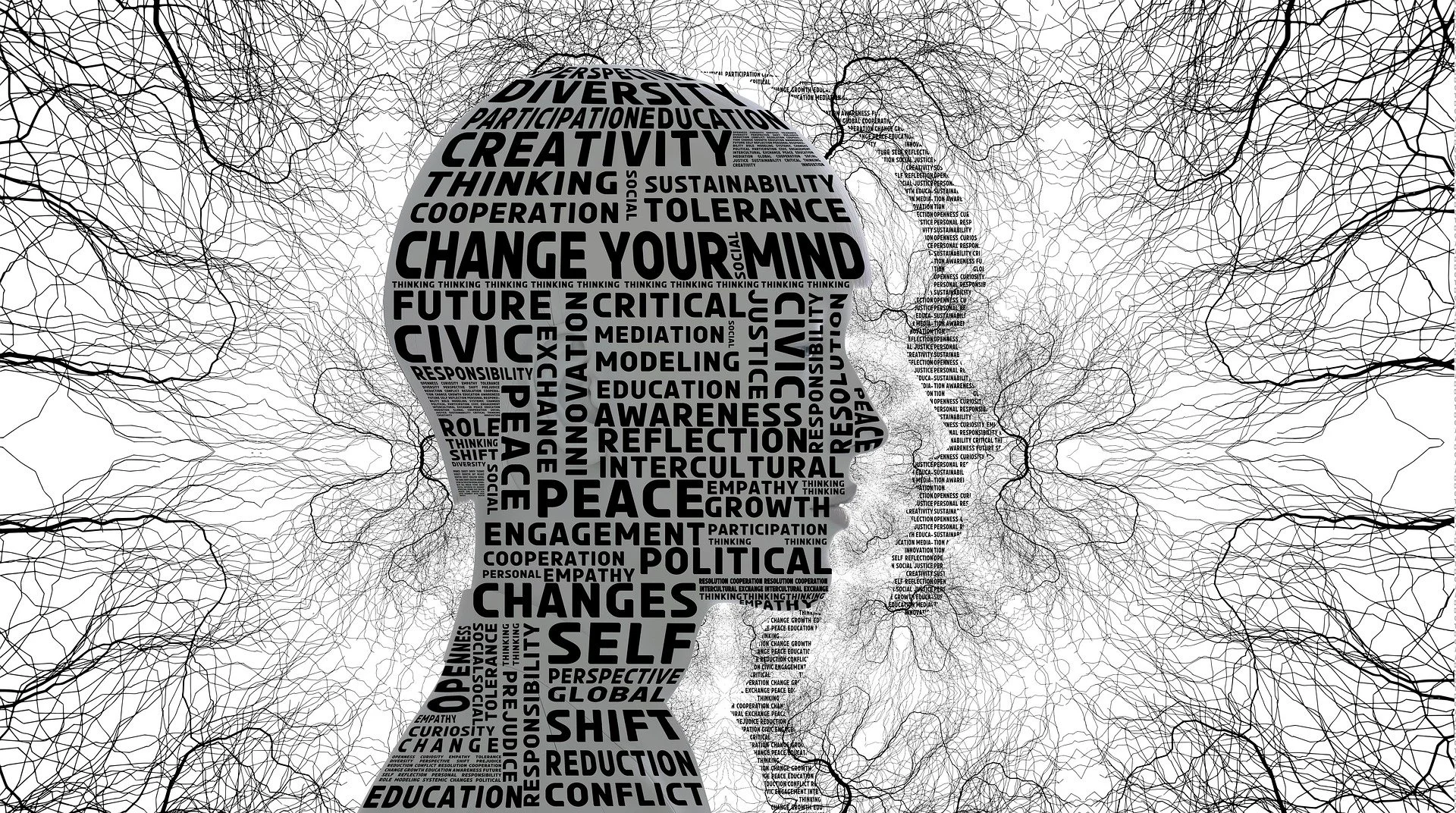
A lot of my work is focused on encouraging clients to change the way they think.
I do this because I follow a Cognitive Behavioural Therapy (CBT) approach to my work. CBT comes as a natural choice for me; however, I also believe that it works.
Simply put, CBT proposes that our thoughts are the source of ALL our problems.
The logic then is that to deal effectively with our problems, we change the content and pattern of the thoughts that support them.
So where is the catch?
Well, changing our thoughts is not simple.
Previously, I outlined in this blog: CLICK HERE the complicated nature of how core beliefs are formed over a very long period.
Internal, personal and external environmental factors are involved in this.
Still, changing our thoughts is possible.
In this blog, I go through a selection of tools that can be used to help change our thoughts.
This is a generic list that will have some crossover between the headings. Some may be more relevant to you than others.
All you need is for one or two of these strategies to resonate with you.
When this happens, it truly is a light bulb moment.
Calm Yourself, Regain Control
Difficulty in changing our thoughts usually starts with an inability to control thoughts in general. Anxiety and depression are the enemies of clear thinking. The mere thought of being told to be calm may make some people anxious.
To overcome this and start to achieve a level of calmness, a good place to start is with controlling your breathing. As you control your breathing, a general level of self-control can be achieved.
Grounding exercises also help you to regain control and calm over your emotions.
A popular grounding exercise is the 5, 4, 3, 2, 1 game. During moments of high anxiety, you list five things you see, four things you hear, three things you touch, two things you smell and one thing you taste. The purpose is to bring you back into experiencing the real place you are in and not the place of acute anxiety or depression.
Mindfulness
Mindfulness is:
“The practice of paying attention to whatever is happening in the present moment and experiencing it without judgement”
Health Services Executive
Mindfulness frees the person to be able to engage with their problem thoughts in an objective manner. I will talk about this more later.
Mindfulness is definitely a buzz phrase of our time. Some people consider it to be a spiritual process and are put off by it.
For me, a mindfulness state is achieved through simple routine household activities that occupy my body but allow my mind to ponder. Gardening is probably my favourite way to let my mind wander.
Self-Help Books, Podcasts, etc.
When it comes to changing your mind to think more positively, there are probably enough books to fill a thousand libraries.
As for podcasts, there are probably new ones every day. And, no, I do not do my own podcast, …as of the time of writing??
The effectiveness of self-help books and podcasts is a very personal choice.
Before you pick one, do your research. What issues are you trying to work with? Are you looking for testimonials of people’s stories or something more clinical? Would a workbook suit you if you feel reading or listening on its own doesn’t engage you?
Whatever you choose, choose wisely.
Repeat What Worked Before
It is unlikely that the negative thoughts you are experiencing have never happened to you before.
How did you handle them?
What worked? What didn’t work?
Can you adapt how you successfully managed your negative thoughts before to the current situation you are in?
It can be energy-saving and self-confirming to simply repeat the successful practices of the past.
Positive Self Talk
What you say and how you say it usually is a reflection of what you are thinking.
However, it can also work the other way. How you talk, especially to and about yourself, greatly influences how you think about the world and your place in it.
If you have a natural tendency to talk negatively in your life, you will possibly do this without any direct cause.
If you keep putting black paint (negative talk) into a bucket of white paint (your mind), it eventually becomes murky grey (negative mood).
So when you fall into negative talk, try some kindness, patience and understanding.
If things really are that bad, ignore it if you can; try to remove yourself from the negativity; dare I say, think happy thoughts.
Practice Faith
Faith is predominantly perceived as a religious concept. However, faith can also be in yourself, humanity, and the idea that what goes around comes around.
From the perspective of changing our thought content and patterns, it can be very helpful to tap into a belief in something bigger than ourselves. It gives us a healthy perspective of the problem.
Practising faith is not a wish factory. For instance, prayer does not usually directly result in positive change.
Practising faith brings you back to an understanding of God’s world, how it works, and your place in it. This can be very helpful in helping us regain perspective when we are lost in our minds’ worries.
Reduce Social Media
Social media can greatly affect what and the way we think. We should not let our thoughts be controlled by a social media algorithm.
The film The Social Reckoning (2026) highlights how Facebook (and let’s be honest, they all do it) pushed people to engage with outrage in their profiles. The algorithms that social media use are to keep us engaged with the platform.
Few things keep us on a social media platform than being provoked to anger, either in agreement or against a social media post.
Consider how this wires your brain. How does it affect your mood and your relationships with people close to you and the world in general?
If there are issues that come up online that trigger you, be careful in choosing to respond. If you choose to respond, don’t enflame an already heated debate. You may well be right in what you are saying, and it may well need to be said, but what effect is it having on you? You could become overly obsessed and lose focus on what is really happening in your life.
What and how we think is a core part of who we are.
We should protect it and not have it controlled by a marketing department manipulating strongly opinionated people.
Be Grateful
Gratitude is simply being thankful for what you have. This can include physical possessions and safety. Emotional possessions are often the most important. Primarily, the love and belonging we gain from close, supportive relationships.
The more we practice gratitude, the more likely we are to have helpful thoughts.
It is common for people to keep a gratitude diary. To simply list for themselves what made their life better today.
It is good to consider the small and the huge blessings in life.
The appreciated coffee you got on your way to work.
Your home that stayed standing for another day.
The storm that covered your local park with a carpet of golden leaves on an autumn day.
The child who ate up all her breakfast without having to be told to do so.
Your spouse asking you how your day went and making plans for a hike over the weekend.
The more you enjoy everyday life, the easier it will be to develop a thinking style that matches it.
Gain a Different Perspective
Imagine you have a magic device that can stop everything around you in a tense situation.
You are now the only person awake in a land of people frozen in time.
You have time now to consider what you should do next.
You have time to think.
You gain a new perspective on how to resolve the tension.
Now you press the magic button.
The world restarts.
Nothing has changed, just you.
You have a new plan.
You know what to do next.
The tension is eased.
Ok that’s fiction. We can not really stop time, but we can usually step away from the situation for a time.
This allows us a breathing space. Step away for a moment from your computer; put on a wash, go for a short walk or have the proverbial cup of tea. We all need to simply stare out the window sometimes.
If you are in a negative engagement with someone, don’t be afraid to step away. Make an excuse if necessary. A toilet break to give yourself a helpful talking-to may be a good idea.
Allowing yourself space and time to consider your thoughts is akin to mindfulness. Mindfulness exercises are what we do when we allow ourselves to step away for a moment.
Try Flipping Your Thoughts
What are the thoughts that are currently causing you so much trouble?
“I am fed up with these people”
“Nobody cares what I think”
“I can not escape from this dangerous situation”
“I am useless at this”
It may seem a bit much to ask for these thoughts to be simply flipped and think the opposite “Yes I can” thoughts.
Could you consider what would be an achievable opposite positive thought for the thoughts that trouble you?
Being fed up with people could become “I can cope with them for the time being”.
Instead of believing no one cares about what you think, say to yourself, “I will confidently tell people my thoughts when a gap opens in the conversation and see what happens”
Believing you are in a useless situation is disempowering. The alternative belief to this would be to affirm your ability to assess, plan and implement an escape. The belief I can’t needs to become I can.
What manageable alternative thoughts can you identify for your situation?
How would they help improve your belief of how life is treating you?
Listen to Yourself
Self-awareness helps us to know and understand our thoughts. The more self-aware we are, the better we can change the what, how and why of our thoughts.
I often ask clients to be aware of their thoughts, emotions, behaviours, and sensations in their bodies.
When we pay attention to what these parts of ourselves are saying, we learn how our mindset about our world affects us.
We also learn how our world affects the views in our mind.
The more we learn from this process, the more it helps us identify what thoughts and resulting decisions could improve our difficulties.
Thought Stopping
Thought stopping is the technique of interrupting negative thoughts.
This can have the beneficial effect of providing temporary relief in a stressful situation.
The concern with telling ourselves to stop a thought is that the thought only goes away for a while and returns with an even stronger impulse. Addictive behaviour is a good example of this.
It is healthy to identify that a thought is harmful and to admit to yourself that you are struggling to overcome it. Hopefully this realisation motivates you to move forward with longer-lasting solutions.
Keep Track of Yourself
As you go through a genuine process of change, it can be helpful to record it.
The record can be kept through a traditional diary, a mood app, etc.
In formal therapy, I may give the client a sheet to record their thoughts, emotions, behaviours and sensations in their body on a day-by-day basis. The point is to help the client see how changes in their mindset are affecting them.
You are recording your progress, or lack of it. Making this record will help you to remember what has or hasn’t worked before.
Records are the basis for your plans for your future.
Finally, The Golden Rule
ACCEPT FAILURE
LEARN FROM EVERYTHING
PRACTICE,
PRACTICE,
PRACTICE!!!
YOU CAN GET THERE
Related Material Elsewhere in the Prevail website
Click on the titles to see the full article
Be solution-focused
If you want a specific change relatively quickly, solution-focused therapy may be a good choice for you.
The idea here is to spend therapy time on solutions and not on discovering underlying causes. It may lead to deeper therapy if that is what the client chooses.
Thoughts are King
A discussion of the role that thoughts play in our lives. Our thoughts are based on our perception of our life experience. This perception goes on to create our core beliefs. From this evolve our emotions, behaviours and sensations in our body.
Managing negative thoughts and behaviours
This article outlines how Prevail works with changing negativity in your life. It covers the approaches that are used and how counselling can help.
When humanity goes ape
A look at the 2017 film War for the Planet of the Apes. How the film represents the changed view of humanity since the beginning of the franchise in 1969. We have a less heroic view of ourselves. Possibly to the point that we see ourselves as the villains now in the world we have created.